
Preparedness gifts should be useful, not apocalyptic.
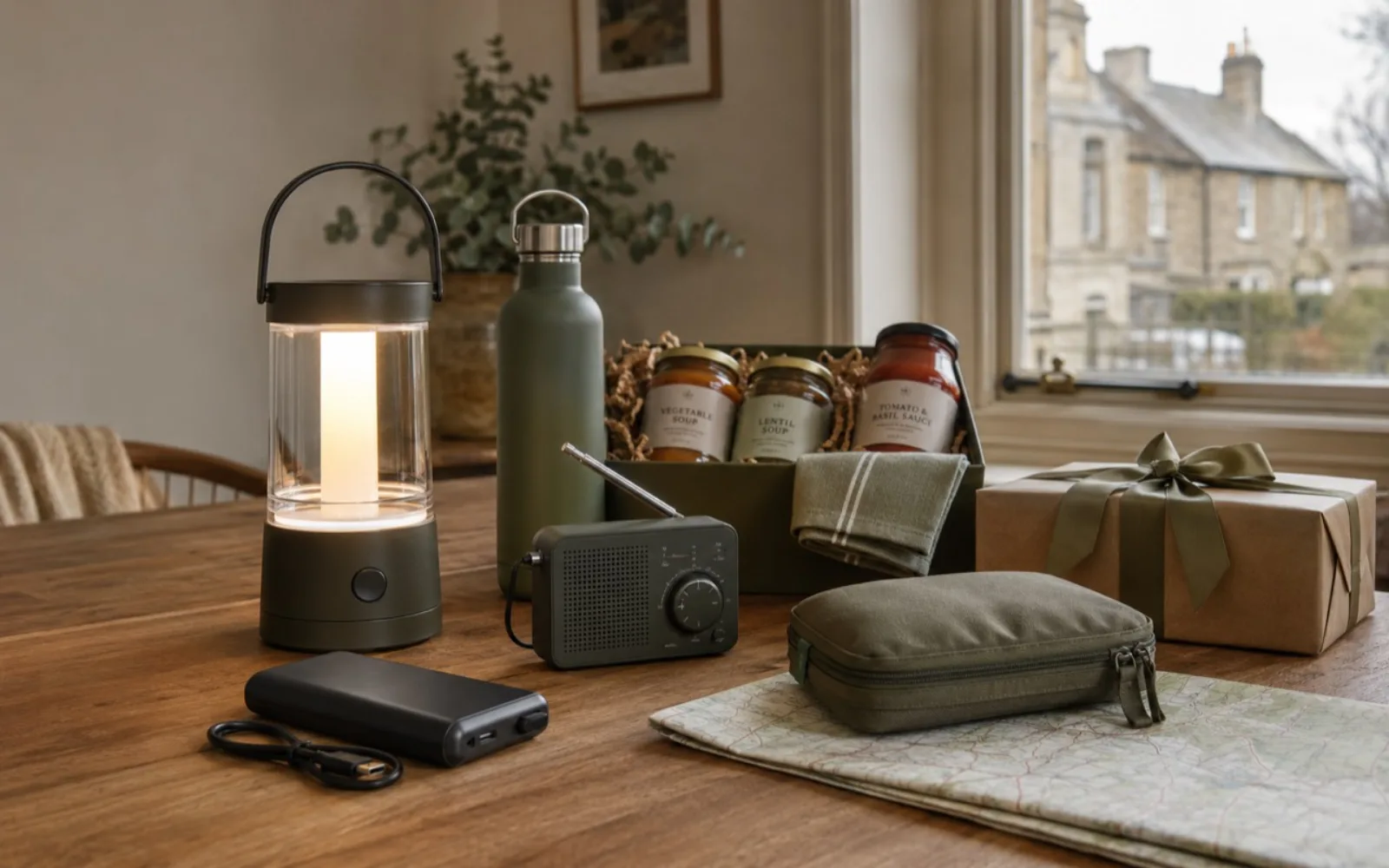
A practical gift can quietly make someone's home easier to live in, especially when weather, travel or supply disruptions get messy. But there is a fine line between a thoughtful useful gift and something that feels like panic buying with ribbon on it.
The best preparedness gifts are the things people know they should probably own, but rarely get around to buying.
Not bunker gear. Not a dramatic emergency hamper. Just useful, well-chosen objects that make ordinary life smoother and less ordinary days easier to handle.
The point is not to scare someone. The point is to give them something useful enough for normal life, and reassuring enough for disruption.
The UK government has put household resilience more visibly into public guidance. Its official Prepare guidance encourages people to keep simple essentials such as a battery or wind-up torch, portable power bank and battery or wind-up radio at home, alongside basic household supplies.
A birthday gift should not feel like a warning. But it does make sense to think more carefully about useful gifts: not only "will they like it?", but "will this make their life easier when plans fall apart?"
Before buying something under the banner of "useful", ask five questions:
If the answer to the last question is no, it probably belongs in a household checklist, not in gift wrap.
Preparedness is a sensitive gift category because it can accidentally sound judgemental.
You are not saying, "You are unprepared." You are saying, "This is a genuinely useful thing I think you will use."
That changes what you should buy and how you should present it.
A lantern can be "for the bedside, garden evenings and the odd power cut", not "for national emergencies". A shelf-stable food set can be "for busy nights when cooking is too much", not "in case shops run out". A power bank can be "for travel and long days out", not "for infrastructure disruption".
The resilience benefit is there, but it should not be the whole message.
| Gift idea | Typical UK price | Best for |
|---|---|---|
| Rechargeable lantern | £25-£70 | Homebodies, campers, garden people |
| Compact power bank | £20-£60 | Travellers, commuters, busy parents |
| Wind-up or rechargeable radio | £25-£80 | Practical people, older relatives, radio listeners |
| Premium pantry gift set | £25-£75 | Food lovers, busy households |
| Large everyday water bottle or fridge dispenser | £20-£60 | Walkers, families, heat-sensitive people |
| First-aid restock pouch | £20-£50 | New homes, families, outdoorsy people |
| Local paper map set | £10-£35 | Walkers, drivers, analogue people |
A rechargeable lantern is more giftable than an emergency torch because it has a life outside a crisis. It can sit on a bedside table, light a hallway during a power cut, work for camping, or make a garden dinner feel warmer in the evening.
Look for 200-500 lumens, a warm 2700-3000K light, dimming, USB-C charging, a stable base and at least 6-12 hours of usable runtime on a lower setting. Avoid tactical torches, novelty lights, cold blue LEDs or anything too weak to light a room.
Most people think of power banks as travel gadgets, but a reliable one kept in a known drawer or bag is one of the simplest household resilience upgrades.
It helps during travel delays, long days out, storms, short power cuts or broadband disruption. Choose a trusted brand, at least 10,000mAh, USB-C input and output, and ideally 20W or higher USB-C PD if you want faster phone charging. Include the right cable if you know their device.
Avoid no-name power banks with inflated capacity claims, very heavy bricks or versions that create cable hassle.
A small radio is one of the clearest preparedness objects, but it needs careful handling as a gift. The wrong version can feel alarmist. The right version feels like a neat, quietly useful household object.
This works best for someone who already likes practical objects, radio, gardening, sheds, camping or old-school reliability. Look for DAB+ and FM, USB charging, a wind-up backup, clear physical controls and a headphone socket if they listen quietly. Avoid overbuilt survival radios covered in gimmicks, cheap models with poor reception or anything that looks like it belongs in a bunker.
This is the giftable version of stored food. Not emergency rations. Think premium soups, pasta sauces, beans, olive oil, noodles, crackers, preserves, coffee, tea or good pantry staples from a maker the recipient would actually enjoy.
It helps build a calm household buffer without making the gift feel like a warning. Favour items with clear best-before dates, normal cooking uses and no need for freezer space. Avoid bulk survival food, huge multipacks, diet-coded products or anything that feels like you are telling them to stockpile.
A beautiful carafe is pleasant, but it is not really preparedness. A large everyday bottle, slim fridge dispenser or well-made water container is more useful.
The gift works because it supports normal life first: walks, heatwaves, gym bags, road trips, picnics and family meals. For one person, a 1L insulated bottle can be enough to feel useful; for a kitchen, a 5L fridge dispenser is a more practical household choice. If there is a short water disruption, it becomes more useful, but that is not the whole reason to own it.
Avoid ugly emergency jugs, oversized camping containers or anything too bulky for their kitchen.
This is not about gifting a dramatic medical kit. It is about the boring things people run out of: plasters, blister patches, burn dressings, antiseptic wipes, small scissors, tape, a thermometer and a tidy pouch.
It suits new homes, families, walkers, cyclists, gardeners and people who like being organised. A compact pouch, waterproof plasters, blister patches and a digital thermometer make it feel more useful than dramatic. Avoid gifting medicines, intimate medical products, or a serious medical kit unless you know they would appreciate it.
This is partly preparedness, partly analogue pleasure, partly weekend inspiration.
A physical map still works if a phone dies, signal disappears or plans change. It also encourages low-cost days out.
Choose somewhere meaningful: their county, a favourite walking area, a national park, a city they love, or a place they keep saying they want to explore. For UK walking, Ordnance Survey Explorer maps are usually better for footpaths; Landranger maps are better for wider road and regional context. Avoid random maps with no personal relevance, novelty scratch maps or anything too large and awkward to use.
| Too vague | Better gift |
|---|---|
| Emergency kit | Warm rechargeable lantern for bedside, garden and power cuts |
| Food supplies | Premium shelf-stable meal set from a brand they would enjoy |
| Water storage | Large everyday bottle or slim fridge dispenser |
| Backup power | Trusted compact power bank with the right cable included |
| Navigation backup | Paper map of somewhere they already love |
Specificity makes the gift feel chosen. Panic makes it feel dumped.
Avoid gifts that make the recipient feel like you are assigning them a problem.
A giant emergency food box may be sensible for some households, but as a birthday gift it can feel strange unless you know the person actively wants that kind of thing. The same goes for survival tools, tactical-looking gear, heavy-duty equipment or anything that turns a celebration into a warning.
Also avoid novelty preparedness items that look useful but fail when needed: weak torches, tiny multi-tools, cheap power banks, flimsy containers or camping products that are really just decorative.
Preparedness gifts should reduce friction, not create theatre.
These gifts are strongest for people who already value useful objects: new homeowners, people living alone for the first time, parents, walkers, campers, commuters, older relatives, practical friends, or anyone who likes having the right thing in the right drawer.
They are weaker for people who dislike practical presents, have limited storage, feel anxious about disruption, or would read the gift as a comment on how prepared they are.
For nearby routes, browse water bottle gift ideas, prepared meal gifts, storage box gifts, walking tour gifts and our earlier note on choosing experience gifts without giving someone extra admin.
A preparedness gift should pass two tests.
It should be useful on an ordinary Tuesday.
And it should still be useful on a difficult one.
That is the difference between thoughtful practicality and panic buying. The best gifts in this category do not shout "emergency". They quietly make someone's life more comfortable, more organised and a little more resilient.
It is a useful household gift that works in normal life and also helps during short disruptions, such as a power cut, travel delay, extreme weather or temporary water issue.
They can be, if they still feel like a gift when nothing goes wrong. Choose warm, well-made, everyday objects rather than alarmist emergency gear.
Start with the official Prepare guidance where it applies, and use Ready Scotland for Scotland or NI Direct for Northern Ireland because official lists can change.
Avoid bulky emergency kits, tactical-looking survival products, cheap electronics and anything that sounds like a judgement on how prepared the recipient is.
Looking for compact everyday extras that fit a stocking? Our stocking filler ideas cover useful picks under about £5, £10 and £15–20.
First published 31 August 2026. Last reviewed 31 August 2026. Official guidance links checked 31 August 2026.